
External Affairs Minister S Jaishankar on Wednesday held wide-ranging talks with his Russian counterpart Sergey Lavrov focusing on the Ukraine conflict, bilateral ties and issues relating to the G20 foreign ministers' meeting.
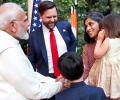
Prime Minister Narendra Modi and US Vice President JD Vance have expressed satisfaction with the progress made in negotiations for a bilateral trade agreement. The two leaders met in New Delhi and discussed a range of bilateral issues, including cooperation in energy, defense, strategic technologies, and other areas. They also exchanged views on regional and global issues of mutual interest.

I will tell you one thing, to be the Foreign Minister of Modi government is also a great strength, Jaishankar said.

Jaishankar also met his Iranian counterpart H Amirabdollahian and held productive discussions on bilateral economic cooperation, Afghanistan and the joint comprehensive plan of action, also known as the Iran nuclear deal.
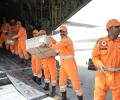
India on Saturday delivered 15 tonnes of relief materials to Myanmar under its 'Operation Brahma' that was launched after a powerful earthquake hit the neighbouring country as well as Thailand.

He said the border situation remained a big problem as the military has been holding its ground for two winters.
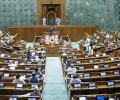
The deportation of Indians from the United States, deaths in the Maha Kumbh stampede and the joint Parliamentary committee report on the Waqf bill were among the issues that led to heated exchanges and some disruptions in an otherwise smooth first part of the Budget session that ended on Thursday.

'Pleasure to meet FM Sergey Lavrov, this time in person. Excellent talks that reflect our Special and Privileged Strategic Partnership. Value our exchanges on the international situation,' Jaishankar tweeted after talks with his Russian counterpart on the sidelines of the SCO meeting.
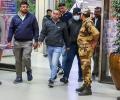
India has raised concerns with the US over the recent deportation of 104 Indian immigrants, with Foreign Secretary Vikram Misri revealing that US authorities have identified up to 487 presumed Indian citizens with "final removal order." Misri also highlighted the "ecosystem to promote illegal migration" and stressed the need for action against those involved in facilitating such operations.
'No retaliatory tariffs now. You can retaliate after a few months.' 'Today, there is no need to retaliate because it is a question of long term benefits.'
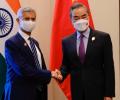
External Affairs Minister S Jaishankar on Thursday conveyed to his Chinese counterpart Wang Yi the need for an early resolution of all outstanding issues along the Line of Actual Control in eastern Ladakh, and asserted that bilateral ties should be based on mutual respect, mutual sensitivity and mutual interest.
Tahawwur Rana, accused in the 2008 Mumbai terror attacks, has been extradited to India after the US Supreme Court denied his last-ditch effort to avoid being sent back. Rana, a close associate of David Coleman Headley, another key conspirator in the attacks, was expected to be extradited "shortly" after his legal appeals failed. This decision comes after a multi-agency team from India traveled to the US to complete all necessary paperwork and legalities with the US authorities. Rana's extradition marks a significant development in the pursuit of justice for the victims of the Mumbai attacks.

Blinken blamed the COVID-19 pandemic for a backlog of visa applications from Indian nationals.
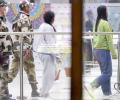
The Indian government has defended the use of Amritsar as a deportation hub for US flights carrying Indian deportees, despite objections from Punjab Chief Minister Bhagwant Mann. Government sources said Punjab has the highest number of deportees among Indian states, with 126 out of 333 people deported since February 5. The sources added that 23 flights carrying Indian deportees have arrived in the country since May 2020, all landing in Amritsar. The move has sparked controversy, with opposition parties protesting the treatment meted out to the deportees and demanding that the Indian government take up the issue with the US. Mann has accused the Centre of trying to defame Punjab and said a holy city like Amritsar should not be made a "deport centre".

India considers the full implementation of the 13th Amendment in Sri Lanka "critical" for achieving reconciliation with the minority Tamil community, External Affairs Minister S Jaishankar said on Friday, underlining that New Delhi has always supported both the political and economic stability in the island nation.
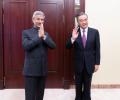
External affairs minister S Jaishankar has told his Chinese counterpart Wang Yi that the two sides should work for an early resolution of the remaining issues along the LAC in eastern Ladakh to restore peace and tranquility in the border areas as this has been an essential basis for progress in Sino-India ties.

Chinese Foreign Minister Qin Gang will travel to India to attend the meeting of G20 foreign ministers on March 2, during which he is expected to hold his first bilateral meeting with External Affairs Minister S Jaishankar.

Jaishankar on Tuesday countered criticism of India's position on Ukraine.
Someone suggested Jaishankar was a potential Kissinger who could try and resolve the Russia-Ukraine imbroglio through his intellectual and diplomatic strengths. But calling the spade a spade on issues like imperialism, colonialism and exploitation, he would have raised many eyebrows in the West at a time when the fractures and wounds needed to be treated and healed, observes Ambassador T P Sreenivasan.

In view of the continued requests of the pilgrims regarding the removal of $20 service charge levied by Pakistan per pilgrim per visit, India has once again urged Pakistan to not levy any fee or charges on the pilgrims, the Ministry of External Affairs (MEA) said in a statement.

At a joint media briefing with Lavrov, Jaishankar listed issues such as "factors of instability" such as terrorism and its cross-border manifestation and said it remains a "major concern".
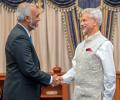
The avoidable stresses and strains in ties helped in one way. It showed for the entire region how a matured India handled diplomatic relations, especially with a smaller and suspicious neighbour, with practised dignity and patience, unruffled by provocations in word, deed and action, observes N Sathiya Moorthy.

In an interaction with a group of Indian journalists, the three-time prime minister and president of the ruling Pakistan Muslim League-N described Jaishankar's visit as a "good opening" and said both sides should now engage and move forward.
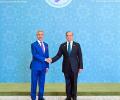
Pakistan Prime Minister Shehbaz Sharif said his country wants to resolve all issues, including Kashmir, with India through talks. He reiterated his "unwavering " support for the Kashmiri people during a speech in Muzaffarabad on the occasion of "Kashmir Solidarity Day. "

The talks took place in a beach resort in Benaulim on the sidelines of a meeting of the Council of Foreign Ministers of the Shanghai Cooperation Organisation.
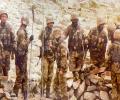
Jaishankar said China, in violation of the 1993 and 1996 agreements not to mass troops on the Line of Actual Control, chose to do so, and added that its attempt was obviously to unilaterally change the LAC.

'If they aim to remain aligned with the public sentiment, as any democratic government should, then they must respond. Why else would the prime minister have cut short his visit to Saudi Arabia? And why would he have instructed the home minister himself to travel to Srinagar to assess the situation firsthand? This suggests that something is indeed being planned. I am quite certain of that, although the exact form it will take remains to be seen.'

External affairs minister S Jaishankar on Tuesday discussed issues relating to Afghanistan and the Indo-Pacific during his bilateral meetings with global counterparts on the sidelines of the annual high-level UN General Assembly session.

The Sri Lankan Navy has arrested 32 Indian fishermen and seized five fishing boats for allegedly venturing into the island nation's territorial waters. This incident is the latest in a series of arrests of Indian fishermen by the Sri Lankan Navy for alleged illegal fishing activities. The issue of fishermen is a contentious one in the relationship between India and Sri Lanka, with past incidents involving firing at fishermen and seizures of boats. This latest incident follows an earlier arrest of 10 Indian fishermen earlier this month and an incident in January where five Indian fishermen were injured after the Sri Lankan Navy fired on them. India has expressed its displeasure regarding the use of force by Sri Lanka.
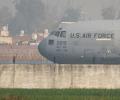
The deportation of 104 Indian nationals from the US, followed by another 119 set to arrive in Amritsar on Saturday night, has sparked controversy in India over the treatment of returnees. The US government's intensified crackdown on undocumented immigrants has led to criticism of the use of handcuffs and shackles for deportees, even those who have committed no crimes beyond immigration violations. The issue has led to heated debates in the Indian Parliament, with opposition leaders demanding an inquiry into the deportation process. The Indian government is engaging with US officials to ensure the humane treatment of deportees, while also facing the challenge of reintegrating returnees into Indian society. The deportations highlight the ongoing tension between border control and human rights, and the complexities of US-India relations.
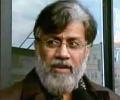
Tahawwur Rana, accused in the 2008 Mumbai terror attacks, has renewed his plea for a stay on his extradition to India, citing health concerns and alleging potential torture. He argues that his extradition would violate US law and the UN Convention Against Torture. Rana's lawyers claim he is at risk of being subjected to torture in Indian detention facilities due to his Pakistani origin, Muslim religion, and medical conditions. The US Supreme Court had previously denied his emergency bid for a stay, but he has now appealed to Chief Justice John Roberts. The US government has declined to provide information on any commitment from India regarding Rana's treatment, further fueling his concerns.
Mumbai terror attack accused Tahawwur Rana has moved an 'emergency application' with the United States Supreme Court against his extradition to India, claiming that he will be tortured there since he is a Muslim of Pakistani origin.
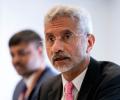
America's relationship with Pakistan has 'not served' either of the two countries, External Affairs Minister S Jaishankar said on Sunday raising questions on the Biden administration's approval of a $450-million sustenance package for F-16 fleet.

Sri Lanka is facing 'a very serious crisis' that makes India naturally worried, External Affairs Minister S Jaishankar told an all-party meeting in New Delhi on Tuesday and dismissed suggestions about such a situation arising in India.
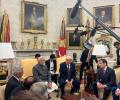
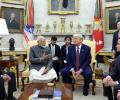
Who accompanied Prime Minister Narendra D Modi to his Thursday meeting with US President Donald J Trump in the Oval Office, and who did POTUS bring along?

His comments came hours after External Affairs Minister S Jaishankar arrived in the Pakistani capital to attend the Council of Heads of Government (CHG) summit of the Shanghai Cooperation Organisation.

Jaishankar said the last few years have been a "period of serious challenge", both for the relationship and for the prospects of Asia, noting that continuation of the current impasse will not benefit either India or China.

The talks took place on the sidelines of the G-20 foreign ministers' meeting in the Indonesian city of Bali.
Tahawwur Rana, accused in the 2008 Mumbai terror attacks, has renewed his application to the US Supreme Court seeking a stay of his extradition to India. The Supreme Court will hear the application next month. Rana, currently detained in Los Angeles, claims his extradition would violate US law and expose him to torture in India due to his health and Muslim background. The US government has denied these claims and authorized his surrender to India, citing the Extradition Treaty between the two countries. The Supreme Court's decision will determine if Rana will face justice in India or remain in the United States.

'Our border guarding forces have also been instructed to be exceptionally alert in view of this complex situation.'
